


Says Genomic and Precision Medicine will shape the Future of Healthcare.
NEW DELHI: Union Minister of State (Independent Charge) for Science & Technology Dr. Jitendra Singh dedicated the UMMID (Unique Methods of Management of Inherited Disorders) Programme for Rare Genetic Disorders/ Diseases to the Nation and said India is steadily entering an era where healthcare, diagnosis and treatment will increasingly become genome-based, precision-driven and individualized according to the genetic profile of every patient.
Dr. Jitendra Singh said inherited and rare genetic disorders remained neglected for decades because diagnosis itself was difficult, treatment inaccessible and medicines either unavailable or prohibitively expensive, making it essential to build a coordinated national mechanism to make diagnosis and management feasible, affordable and accessible for all families.
Describing UMMID as a major step towards the future of precision medicine in India, the Minister said the initiative would also prepare the country’s healthcare ecosystem for the next generation of gene and genome-based medical care.
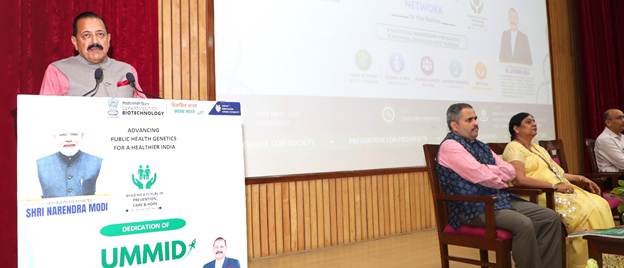
The Union Minister was addressing a special function organised by the Department of Biotechnology for dedication of the UMMID Network to the Nation at Prithvi Bhawan, New Delhi. On the occasion, the Minister also released the UMMID Compendium and launched the UMMID Dashboard aimed at strengthening nationwide access to diagnostics, counselling, outreach and programme monitoring for inherited disorders.
The event was attended by Secretary, Department of Biotechnology and Director General, BRIC, Dr. Rajesh S. Gokhale; Senior Adviser, DBT, Dr. Suchita Ninawe; senior scientists, clinicians, healthcare professionals, representatives of UMMID implementing institutions and officials from scientific and healthcare organisations across the country.
Referring to the healthcare reforms introduced under Prime Minister Narendra Modi’s leadership over the last decade, Dr. Jitendra Singh said the Government has consistently focused on healthcare that is affordable, accessible, preventive and citizen-centric. He said India has expanded wellness centres, strengthened health insurance coverage and widened access to affordable medicines while simultaneously building systems for early detection and preventive healthcare.
The Minister said inherited and rare genetic disorders represent a silent but deeply challenging public health burden, where families often spend years moving from one hospital to another in search of diagnosis and treatment. He said despite affecting comparatively smaller populations, these disorders impose enormous emotional, social and financial hardship on affected families and therefore deserve the same level of national attention and healthcare sensitivity as any other major disease burden.
Sharing his perspective as a medical professional, Dr. Jitendra Singh said rare genetic disorders historically received limited attention in mainstream medical education and healthcare practice because of their low prevalence and complex diagnosis process. He said this often resulted in delayed diagnosis, lack of awareness and inadequate treatment access for patients. He added that India’s vast genetic diversity further makes the challenge more complex and requires a robust ecosystem of early screening, genetic diagnostics, prenatal counselling, clinician training and community outreach.
Appreciating the Department of Biotechnology for taking up a difficult but socially transformative mission, Dr. Jitendra Singh said UMMID demonstrates how science, compassion and public policy can come together to reduce suffering through timely intervention and preventive healthcare. He said the programme has successfully established a national framework integrating genetic diagnostics, prenatal and newborn screening, genetic counselling, clinician capacity-building and community outreach under a unified public health model.
The Minister said the programme has already benefited nearly three lakh individuals through screening and diagnostic services and expanded outreach across Aspirational Districts and underserved regions. He said the initiative has also helped establish nearly 30 NIDAN Kendras for advanced diagnostics and counselling, ensuring that advanced genomic healthcare reaches beyond metropolitan centres and becomes accessible to ordinary citizens.
Dr. Jitendra Singh said the experience gained through UMMID would serve as an important foundation for the future of precision medicine, where treatment protocols for diseases such as diabetes, cardiac ailments and cancers may increasingly be based on the individual genetic profile of patients. He said genetic medicine and nuclear medicine are emerging as two major frontiers that could redefine healthcare in the coming decades.