

Future of 6G must be built on interoperability, common standards, innovation and inclusive growth: Scindia

Says AI, spectrum planning, network architecture and emerging applications identified as key pillars of future 6G systems.
NEW DELHI: Union Minister of Communications and Development of North Eastern Region, Jyotiraditya M. Scindia, emphasised on India’s ambition to play a meaningful role in shaping the global telecommunications architecture of the future. He stated, “As we advance on this journey, our role must be anchored in four key pillars. First, ensuring global interoperability—across devices, networks and services—so that the world communicates seamlessly within a unified ecosystem. Second, developing a common technical framework, in collaboration with global bodies such as 3GPP and ITU, to establish shared standards across radio interfaces, core networks, spectrum and service architecture. Third, accelerating innovation and research, where clear global standards guide researchers, startups and industry in transforming breakthroughs into real-world solutions.
Fourth, and most importantly, ensuring inclusive growth and indigenous innovation. Open standards create a level playing field, enabling nations to contribute, build intellectual property and ensure that the benefits of technology reach every citizen across the globe. To realise these pillars, sustained international cooperation, global dialogue and continuous engagement are essential.”
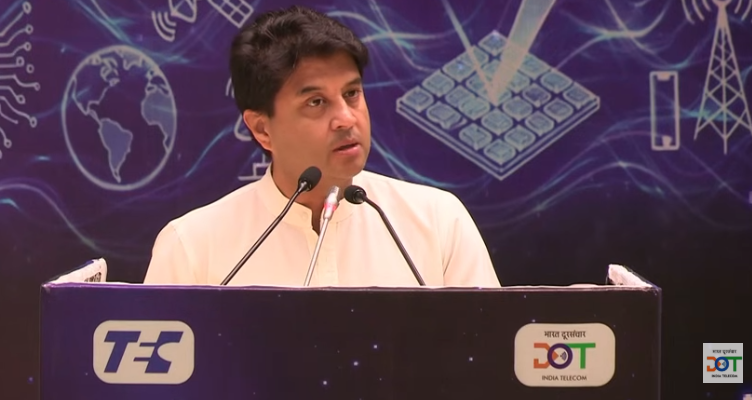
Union Minister Scindia was delivering his inaugural address at an International Workshop on 6G Standardization at Vigyan Bhawan, New Delhi. Amit Agrawal, Chairman DCC and Secretary (Telecom); Manish Sinha, Member (Finance); Rudra Narayan Palai, Member (Technology) and Deb Kumar Chakrabarti, Member (Services) were among the dignitaries present on the dais. The workshop was organised by the Telecommunication Engineering Centre (TEC), the technical arm of the Department of Telecommunications (DoT). The event brought together leading experts from government, academia, industry and international standardisation bodies to deliberate on the evolving global roadmap for sixth generation telecommunications technologies.
The workshop served as an important platform to review global developments in 6G research, spectrum planning, network architecture, artificial intelligence-enabled networks and emerging applications, while strengthening India’s participation in international standards development processes.
“Under the leadership of Prime Minister Narendra Modi, the Bharat 6G Alliance was established in 2022, articulating India’s Bharat 6G Vision. Our ambition is clear—to contribute at least 10 per cent to global standards and patents as 6G evolves.”, said Jyotiraditya M. Scindia.
He emphasised that “The promise of 6G lies not only in technological sophistication, but also in the democratisation of opportunity. It is here that India’s story comes to the fore on the global stage.” Union Minister Scindia concluded, saying, “Let us pledge today to build a secure, resilient and truly global 6G ecosystem—one that connects not just devices, but people, opportunities and possibilities across the length and breadth of our world.”