

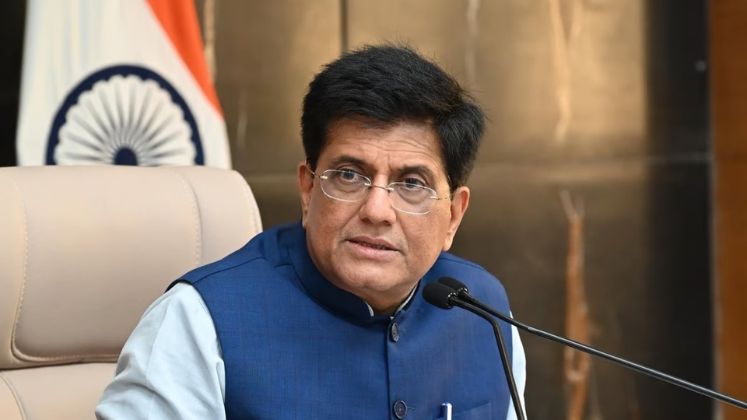
India engaging with over a dozen countries and regions on trade and economic partnerships: Piyush Goyal

Says government to give full support for climate action.
NEW DELHI: Union Minister of Commerce & Industry Piyush Goyal delivered the keynote address at the ‘Advancing Resilience with Climate Change’ dialogue in New Delhi, highlighting India’s emergence as a global leader in climate action, its strong performance in achieving Intended Nationally Determined Contributions (INDCs), rapid expansion of renewable energy capacity, and ongoing global economic engagements with multiple countries and regions.
He stated that India is among the best performing countries globally in achieving its INDCs, consistently ranking among the top 1–3 countries in the G20, and noted that the country met its renewable energy goals eight years ahead of schedule, with 260 gigawatts already achieved. He recalled that when the government assumed office in 2014, the earlier plan was for 20 gigawatts of solar capacity over 9–10 years, which was scaled up to 100 gigawatts under Prime Minister Narendra Modi’s direction and achieved within time. India has now set an ambitious target of 500 gigawatts of clean energy capacity by 2030.
Recalling India’s leadership at the Paris COP21, Goyal said that under the leadership of Prime Minister Narendra Modi, India brought together developed, developing, and less developed countries to arrive at a consensus-based outcome that allowed flexibility for nations to define their own targets. He noted that India transitioned from being seen as a naysayer to a global leader, with the Prime Minister playing a pivotal role during the negotiations alongside the then French President.
Highlighting India’s growing global economic engagement, he stated that multiple countries and regions are in active dialogue with India on trade and economic partnerships. He noted that engagements are underway with another 12 countries and regions, including Peru, Chile, Canada, Qatar, Bahrain, Saudi Arabia; South Africa and its neighbouring regions; Brazil and its neighbouring regions; Russia and the Eurasian region; and Israel. He emphasized that the world today recognizes the India growth story and the country’s importance in opening doors for Indian businesses across global markets.
Stressing the link between good economics and good outcomes, he noted that India’s growth story and policy approach have gained global recognition. He underscored the importance of providing an enabling economic environment with ease of doing business and ease of living, supported by innovation, startups, and emerging technologies.
The Minister emphasized that over the past decade, climate action in India has transformed from being viewed as a compulsion into an economically viable proposition. He noted that despite the developed world not fulfilling commitments on funding and technology, India has performed admirably and continues to advance climate action while maintaining growth. He highlighted that leading companies in the renewable energy sector are contributing to job creation, economic activity, and future export potential in capital goods, power, technology, and services.
Goyal highlighted key structural reforms in the power sector, particularly the creation of a unified national grid under the “One Nation, One Grid” vision. He recalled that at the time when large parts of northern India faced a grid failure, and regional grids operated in isolation, leading to disparities such as high power costs in southern India (up to ₹12 per unit during peak hours) while power remained underutilized elsewhere. The integration of grids enabled efficient distribution, reducing costs to around ₹2.5–3 per unit and ensuring optimal utilization of generation capacity. He also noted the extensive expansion of transmission infrastructure, revival of stalled power projects, and the need for strong base load capacity to support intermittent renewable energy.
He further mentioned that extensive planning, including around 29 studies on renewable energy scenarios, helped guide infrastructure and capacity decisions. Reflecting on his own learning experience despite not having an engineering background, he acknowledged inputs from experts and institutions, including suggestions to engage with programmes related to clean energy.
The Minister also highlighted India’s rapid transition to energy-efficient LED lighting, noting that removal of subsidies and the introduction of data-driven approaches enabled the country to shift from traditional lighting systems to LED lighting across the country within three years—the fastest such transition globally—resulting in significant energy and carbon savings.
He also elaborated on the importance of efficiency and behavioural change, citing everyday examples such as saving water, switching off unused lights and appliances, maintaining equipment efficiency, and reducing energy consumption across sectors. He emphasized that collective action—from individuals to industries—is essential to achieving climate goals and unlocking economic opportunities, including those estimated in emerging sectors.
Concluding his address, Goyal invoked the principle of trusteeship, recalling that humanity holds the planet in trust for future generations. He emphasized that climate justice, equity, and inter-generational responsibility require collective consciousness and action from governments, businesses, and citizens alike. He assured full support of the Government of India for all efforts aimed at making the world more secure, resilient, and sustainable, and called upon all stakeholders to commit to building a better future.