


Surpasses Brazil to secure third position in Global Renewable Energy Rankings.
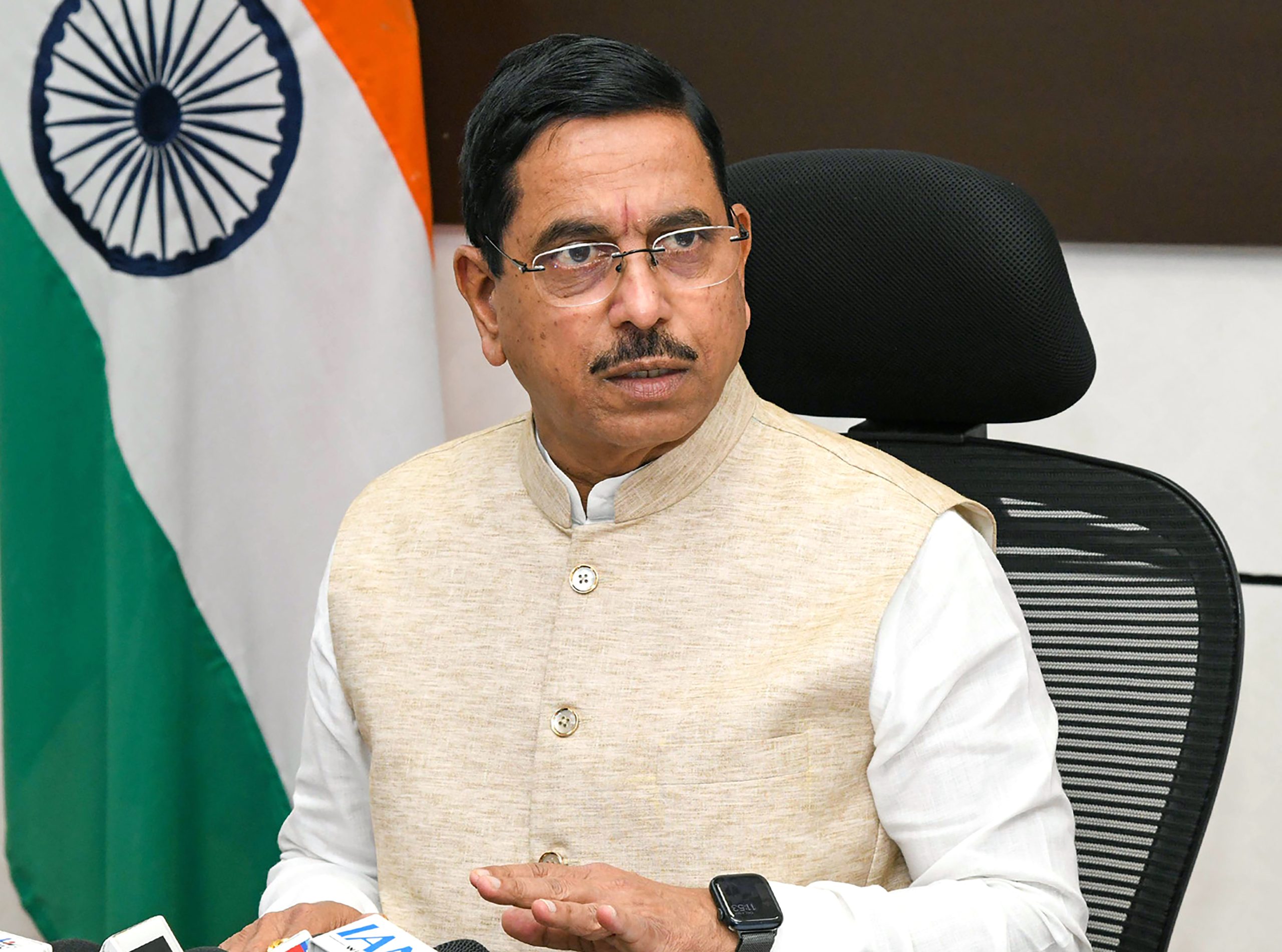
NEW DELHI: Union Minister for New and Renewable Energy and Consumer Affairs, Food and Public Distribution Pralhad Joshi said India ranks third globally in Renewable Energy Installed Capacity, according to the Renewable Energy Statistics 2026. He said India has moved ahead of Brazil in the ranking. The International Renewable Energy Agency released the statistics as of December 2025.
While addressing media persons here today, Joshi said India achieved a total non-fossil capacity addition of 55.3 GW during FY 2025–26.
The Minister also highlighted that in July 2025, India reached its highest-ever renewable energy share in electricity generation. The renewables met 51.5% of the country’s total electricity demand of 203 GW. He also said that a total of 283.46 GW of capacity from non-fossil fuel sources has been installed in the country as on 31.03.2026.
Joshi said India's total power generation during 2025-26 (up to March 2026) reached 1,845.921 BU. The share of non-fossil fuels in total generation reached 29.2% in 2025-26 (538.97 BU). India achieved the milestone of 50% of its cumulative electric power installed capacity from non-fossil fuel sources in June 2025, five years ahead of the 2030 target set under its Nationally Determined Contribution (NDC) to the Paris Agreement.
In line with the Prime Minister’s announcement at COP26, the Ministry of New and Renewable Energy is working towards achieving 500 GW of installed electricity capacity from non-fossil sources by 2030.
So far, a total of 283.46 GW of capacity from non-fossil fuel sources has been installed in the country as on 31.03.2026. This includes 274.68 GW Renewable Energy (150.26 GW Solar Power, 56.09 GW Wind Power, 11.75 GW Bio Energy, 5.17 GW Small Hydro Power, 51.41 GW Large Hydro Power) and 8.78 GW Nuclear Power capacity.Non-Fossil capacity addition in 2025-26 is 55.29 GW and this is the highest increase in any year. (Previously the highest increase was 29.5 GW during 2024-25).
Distributed Renewable Energy (DRE) from Solar has emerged as a significant component of this growth, contributing 16.3 GW (36%) out of the 44.61 GW installed during 2025–26. This includes 7.6 GW under PM KUSUM and 8.7 GW from rooftop solar.
During 2025-26, Wind energy capacity of 6.05 GW has been installed, which is the highest ever capacity addition in a single year. (In the previous year, the wind capacity addition was 4.15 GW).
Renewable Energy (RE) installed capacity has increased 3.59 times since 2014 - increased from 76.38 GW in March 2014 to 274.68 GW in March 2026 i.e. an increase of 198.30 GW.
Solar energy installed capacity has increased 53.28 times since 2014 - increased from 2.82 GW in March 2014 to 150.26 GW in March 2026, i.e. an increase of 147.44 GW.
Wind energy installed capacity has increased 2.66 times since 2014 - increased from 21.04 GW in March 2014 to 56.09 GW in March 2026, i.e. an increase of 35.05 GW.
Wind Turbine Manufacturing Capacity has increased from 10 GW in 2014 to about 24 GW, as on 31.03.2026.
Solar Module Manufacturing Capacity has increased from 2.3 GW in 2014 to about 172 GW, as on 31.03.2026.
In FY 2025–26, an expenditure of Rs. 24,176.68 crore has been incurred against the B.E. of 26,549.38 crore and R.E. of 25,301.22 crore, which is ~91.0% of the B.E. and ~95.5% of the R.E.
Key Policy Implemented by the Ministry of New & Renewable Energy (MNRE) in FY 2025-26
The GST rate on renewable energy devices & parts for their manufacture was reduced from 12% to 5%, w.e.f. 22.09.2025. This will benefit domestic buyers: project developers, DISCOMs, rooftop solar installers, and captive users, by reducing the landed cost of solar equipment.
BCD exemption extended to capital goods for lithium-ion cell manufacturing for Battery Energy Storage Systems (effective 2 February 2026 to 31 March 2028). This will reduce the reliance on imported battery packs, primarily from China, strengthening India's Atmanirbhar Bharat goals in the energy sector.
Renewable Energy Equipment Import Monitoring System (REEIMS) portal, launched in October 2025 enabled real-time tracking of import patterns of critical renewable energy equipment, ensuring greater supply chain transparency, regulatory compliance, and prevention of misuse of imported components.
On the recommendation of MNRE, MoP has revised the RCO compliance framework under the Energy Conservation Act, 2001, superseding the earlier October 2023 notification. State-level RPO targets are subsumed within this unified RCO framework, eliminating dual obligations under the Electricity Act, 2003.
CERC (Sharing of Inter-State Transmission Charges and Losses) (Fourth Amendment) Regulations, 2025 issued on 26.06.2025 to provide ISTS waiver trajectory for RE and BESS projects, including provision of extension of waiver in case of delay on account of Force Majeure event including non-availability of transmission system or for reasons not attributable to the Renewable Energy Generator.
CERC (Connectivity and General Network Access to the Inter-State Transmission System) (Third Amendment) Regulations, 2025 introduced a non-solar hour connectivity framework. This will help in better utilization of the transmission network.
Guidelines for Virtual Power Purchase Agreements (VPPA) issued by CERC. VPPA provides an additional instrument to enable the Designated Consumers to meet their RCO targets.
Pilot Scheme for Contract for Difference (CfD) for RE projects of 500 MW capacity issued by MNRE. The CfD mechanism, a globally proven framework, guarantees stable revenues to renewable energy developers while preserving competitive, market-based price discovery.
The National Policy on Geothermal Energy was issued in September 2025, providing a comprehensive strategic framework to accelerate the exploration, development, and commercial utilization of geothermal resources across the country.
The Ministry has formally inaugurated the Jaiv-Urja Mitra programme under the Human Resource Development (HRD) framework. This strategic initiative is designed to bolster the renewable energy value chain by providing specialized technical training and capacity-building for key stakeholders, including biomass aggregators, feedstock depot operators, and Compressed Biogas (CBG) technicians.
The Ministry has issued the modified "Solar Systems, Devices, and Components Goods Order, 2025" (Quality Control Order (QCO) 2025) via Gazette Notification dated 27th January 2025. This revised order supersedes erstwhile QCO, 2017 and incorporates the latest versions of Indian Standards for Solar PV Modules, Storage Batteries, and SPV Inverters. The order also provides standards for the determination of efficiency of SPV modules.