

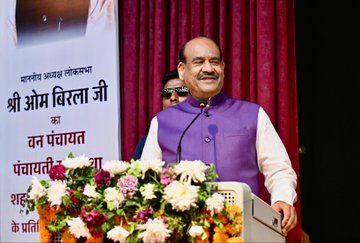
Om Birla addresses representatives of Van Panchayats, Panchayati Raj Institutions and Urban Local Bodies

Calls for collective action for sustainable conservation.
NEW DELHI: Lok Sabha Speaker Om Birla called for a coordinated and proactive approach involving all stakeholders — government institutions, Panchayati Raj Institutions, Urban Local Bodies, Van Panchayats, and citizens — to ensure sustainable development and ecological balance. He emphasized that empowering local communities and respecting traditional knowledge systems are essential for long-term environmental sustainability and national progress.
Addressing representatives of Van Panchayats, elected members of the three-tier Panchayati Raj system, and Urban Local Bodies at Dr. Raghunandan Singh Tolia Administrative Academy, Nainital, Birla noted that Uttarakhand’s Van Panchayats have emerged as a successful model of community-based forest management. He said that these institutions are contributing not only to conservation and regeneration of forests but also to livelihood generation and the vision of an Atmanirbhar Bharat.
During the programme, he also interacted directly with the representatives and listened to their experiences, challenges, and suggestions.
Describing Van Panchayats as “the strongest link in India’s democratic framework,” Birla underlined that grassroots institutions play a vital role in conservation and governance. He remarked that interacting with Van Panchayats is akin to engaging with the most robust pillar of democracy and observed that the experience of these local bodies is no less significant than that of institutions at the national level.
Highlighting the intrinsic relationship between Jal (water), Jangal (forests), and Jameen (land), Birla said these natural resources form the foundation of ecological balance and human sustenance. He stressed that their conservation is not merely an environmental necessity but a collective responsibility that requires active participation at the grassroots level.
Lauding Uttarakhand’s rich cultural and environmental heritage, Birla said the State represents a living example of harmonious coexistence between humans and nature. He acknowledged the invaluable contributions of local communities in protecting forests and biodiversity, noting that traditions such as reverence for water and trees continue to guide sustainable practices.
Referring to the historical context, Birla recalled the resistance of local communities during the colonial period against exploitative forest policies. He noted that since the 1930s, sustained efforts have been made through laws and policies to strengthen forest conservation, while emphasizing the need to address implementation challenges to ensure effective outcomes at the grassroots level.
Underscoring the role of local communities, Birla emphasized that conservation of forests and wildlife habitats can only be achieved through their active participation. He urged Panchayati Raj Institutions, Urban Local Bodies, and Van Panchayats to act as catalysts in mobilizing community efforts, promoting eco-friendly livelihoods, and ensuring balanced and sustainable development.
Highlighting the growing global recognition of yoga and Ayurveda, Birla said Uttarakhand is a major centre of these traditional knowledge systems. He called for the development of a comprehensive action plan for medicinal plants in collaboration with Van Panchayats, including value addition, research, and integration with modern healthcare systems. He noted that while extensive research has been undertaken in allopathy, greater focus is needed on medicinal plants and traditional knowledge.
He also emphasized that local communities possess valuable experiential knowledge, particularly in dealing with challenges such as forest fires, where their on-ground expertise is critical. He said this reflects the true strength of democracy, where even the voice of the last person is heard and valued in governance.
Referring to the global challenge of climate change, Birla stressed that community participation is key to mitigation and adaptation efforts. He also referred to Prime Minister Narendra Modi’s call for an environmentally sustainable lifestyle, stating that Uttarakhand’s Van Panchayat model can serve as an example for the world. He further appreciated the active participation of women in the state, noting their significant role in forest conservation.
During the interaction, representatives of Van Panchayats shared their views on issues such as forest fire prevention, institutional strengthening, financial assistance, and technical support. Birla assured that their suggestions and concerns would be taken forward at the national level.