

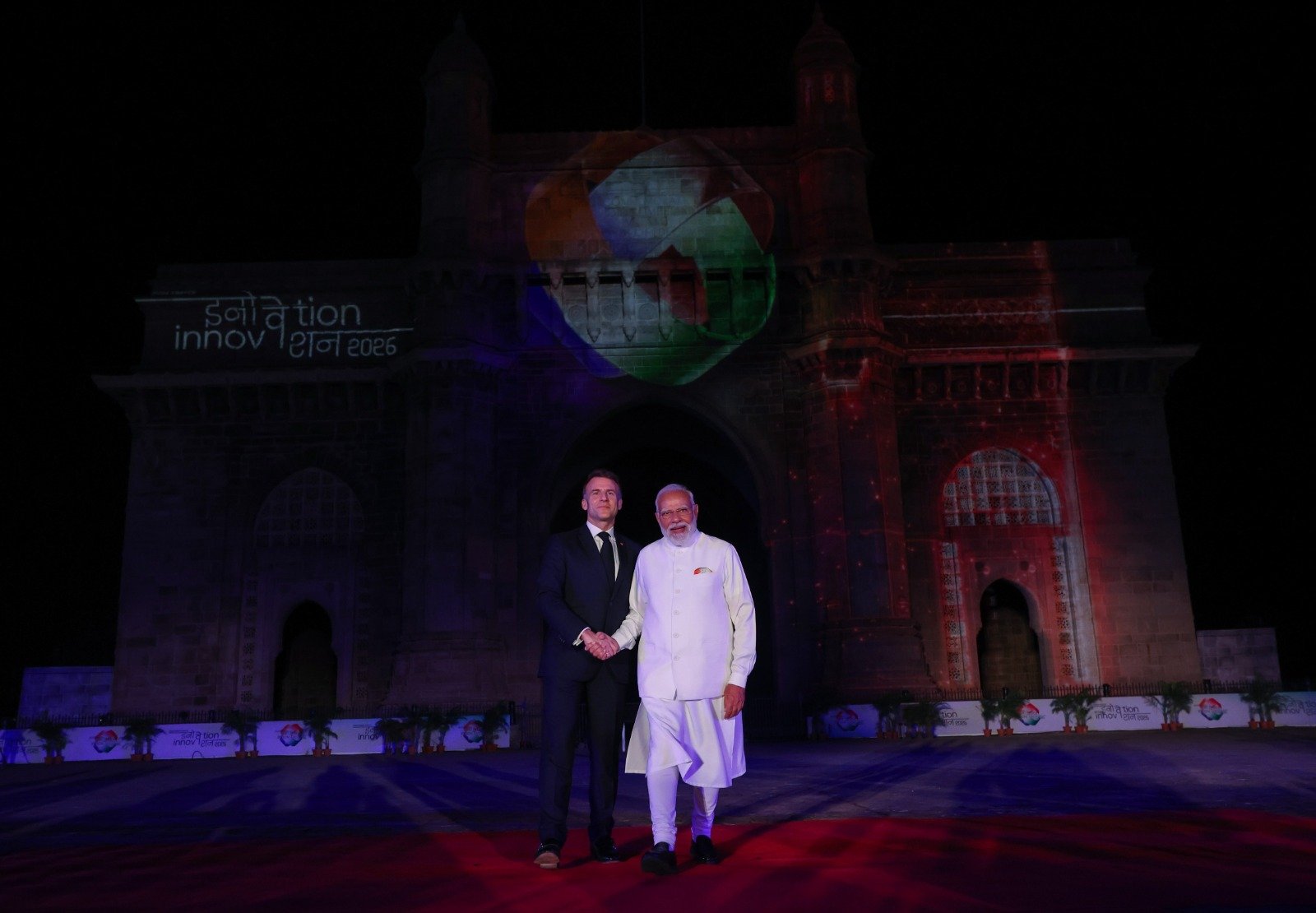

Both leaders agree to elevate relations to a Special Global Strategic Partnership.
NEW DELHI: Prime Minister Narendra Modi and French President Emmanuel Macron held bilateral talks and jointly inaugurated the 2026 India-France Year of Innovation in Mumbai.
On the occasion, both leaders agreed to elevate relations to a "Special Global Strategic Partnership” to guide bilateral cooperation in the coming decades. The upgrading of relations reflects the growing ambitions and vision shared by the two leaders on India-France relationship, to act as a force for global good that can help build not only prosperity and resilience in their economies and advance their countries’ security, but also work collectively towards addressing challenges in an increasingly uncertain global environment and, thus, help build a stable rules-based international order. Both countries celebrated the 25th anniversary of the Strategic Partnership in 2023, on the occasion of which they adopted the Horizon 2047 Roadmap to set the course for the bilateral relationship up to 2047, the centenary year of India's independence, the centenary of diplomatic relations between the two countries and 50 years of Strategic Partnership. The leaders established an annual Foreign Ministers Comprehensive Dialogue for regularly reviewing the progress of bilateral cooperation and implementation of the elevated partnership, and the Horizon 2047, in particular, in the areas of economic security, global issues and people to people exchanges.
India and France have a long history of collaboration in defence and security which has only deepened with a focus on co-design, co-development and co-production of defence platforms and France has emerged as India's one of the foremost defence partners in the world. Both countries have deepened collaboration in civil nuclear energy, through fruitful discussions on potential collaborations in both large capacity nuclear power plants and emerging areas such as Small Modular Reactors and Advanced Modular Reactors. Both countries have long-standing cooperation in the domain of space, including in areas such as joint satellite development, launchers and human flight programs. Both countries have expanded and diversified cooperation in areas such as artificial intelligence, innovation, research, technology, digital and cyber space, health, culture, economy, educational links and people to people exchanges. Trade and investment links between the two countries have deepened and both countries are cooperating on building trusted, reliable and resilient supply chains, as well as safeguarding their economic security. Through the establishment of a Special Global Strategic Partnership, India and France are committed to deeper cooperation and coordination at bilateral, regional and global levels, guided by the India-France Horizon 2047 Roadmap.
Both leaders, acknowledging the importance of advancing scientific knowledge, research and innovation, and the long and enduring engagement between India and France in these areas, jointly inaugurated the 2026 India-France Year of Innovation. This year will feature a series of high-impact collaborations in India and France spanning diverse sectors such as Innovation, Science and Technology, Cyberspace and Artificial Intelligence, Healthcare, Sustainable Development, Cultural and Creative Economy, and Research and Education. These engagements aim to enrich existing collaborations and foster new collaborations between startups, academic institutions, research bodies and industry, showcasing the shared commitment of India and France to co-develop solutions for a smarter, more sustainable future.
President Macron congratulated Prime Minister Modi on India’s successful organization of AI Impact Summit. The summit, while addressing the risks, also highlighted the opportunities offered by AI and built on the progress made in the AI Action Summit, hosted by France and co-chaired by President Macron and Prime Minister Modi in Paris in February 2025. Recalling the India-France Declaration on Artificial Intelligence, both leaders expressed their commitment towards a secure and trustworthy AI serving people, public interest, planet and the progress of our peoples. Both sides also affirmed democratizing AI resources through openness and bridging the global AI divide as important principles. France also contributed significantly as a co-chair of the Working Group on Resilience, Innovation and Efficiency.
President Macron extended an invitation to Prime Minister Narendra Modi to participate in the G7 Summit to be hosted by France in 2026 and invited India to participate actively in the discussions and preparatory work ahead of the Summit, mainly on the key issues of tackling global macroeconomic imbalances and defining a new paradigm for international partnerships and solidarity. Prime Minister Modi warmly welcomed the invitation, noting India’s longstanding partnership with the G7 and its commitment to contributing constructively to global discussions on addressing global economic imbalances, development financing, international partnership, economic security, resilient supply chains, climate action and international security. Both leaders expressed confidence that India’s participation would further strengthen collective efforts to address global challenges and promote a more balanced, inclusive, and resilient international order. Both leaders stressed the importance of collective efforts in order to address together global challenges, especially macroeconomic issues.
President Macron recalled the invitation extended jointly with President Ruto to Prime Minister Modi to participate in the "Africa Forward: Partnerships between Africa and France for Innovation and Growth” Summit, to be held on May 11 and 12, 2026, in Nairobi, Kenya. Considering India’s longstanding and friendly engagement with both France and African countries, Prime Minister Modi thanked for the invitation and reaffirmed support in areas of mutual interest, in particular energy transition, artificial intelligence, health, agriculture and blue economy.
The two leaders reaffirmed their commitment to a rules-based order in the Indo-Pacific region and beyond. The elevation of the relationship will strengthen cooperation between the two countries in sectors of the future, so as to reinforce their sovereignty and decision-making autonomy, and to respond together to the major challenges confronting our world, including through cooperation between India and the European Union.
They reiterated their call for reformed and effective multilateralism to sustain an equitable and peaceful international order, address pressing global challenges and prepare the world for emerging developments, including in the technological and economic domains. The two leaders stressed, in particular, the urgent need for the reform of the United Nations Security Council. They agreed to coordinate closely in multilateral fora, including on UNSC matters, and pledged to continue their efforts to conclude intergovernmental negotiations on the reform of the United Nations Security Council. France reiterated its firm support for India’s permanent membership of the United Nations Security Council. They agreed to strengthen conversations on regulation of use of the veto in cases of mass atrocities. They held extensive discussions on long-term global challenges and current international developments and agreed to intensify their engagement.
Both leaders also underlined the key importance of strengthening EU-India relations and welcomed the historic summit between India and the EU, during which the negotiations of the India-EU Free Trade Agreement were concluded. The FTA will open opportunities for further economic collaboration between India, France and Europe, strengthening the competitiveness of our businesses, ushering in a new era of sustainable prosperity and resilient value chains. Both leaders welcomed the conclusion of the Security and Defense Partnership, which will contribute to the strategic autonomy of the EU and India, and will provide a framework for in-depth exchanges and cooperation on common security challenges such as maritime security, cybersecurity, hybrid threats, space and counterterrorism, and for promoting mutually beneficial defence industrial collaboration.
The two leaders reiterated their concern over the war in Ukraine, which continues to cause immense human suffering and negative global consequences. They stressed the importance of cessation of hostilities and expressed support for a comprehensive, just and lasting peace in Ukraine through dialogue and diplomacy in accordance with the principles of the UN Charter and international law, including independence, sovereignty and territorial integrity.
The two sides discussed the recent developments of concern in Iran and the region. They underscored the importance of dialogue and diplomacy in resolving issues in a peaceful manner.
Both leaders expressed their support to the implementation of the Peace Plan for Gaza in accordance with the Resolution 2803 adopted by the United Nations Security Council and principles enshrined in the New York Declaration. They encouraged all parties to implement the resolution in its entirety. Both sides restated their readiness to support efforts towards just and durable peace and stressed the need for rapid, safe and unimpeded aid delivery throughout the Gaza strip. Both Leaders reiterated the commitment of India and France for a just and lasting solution, based on the implementation of the two-state solution, through dialogue and diplomacy.