

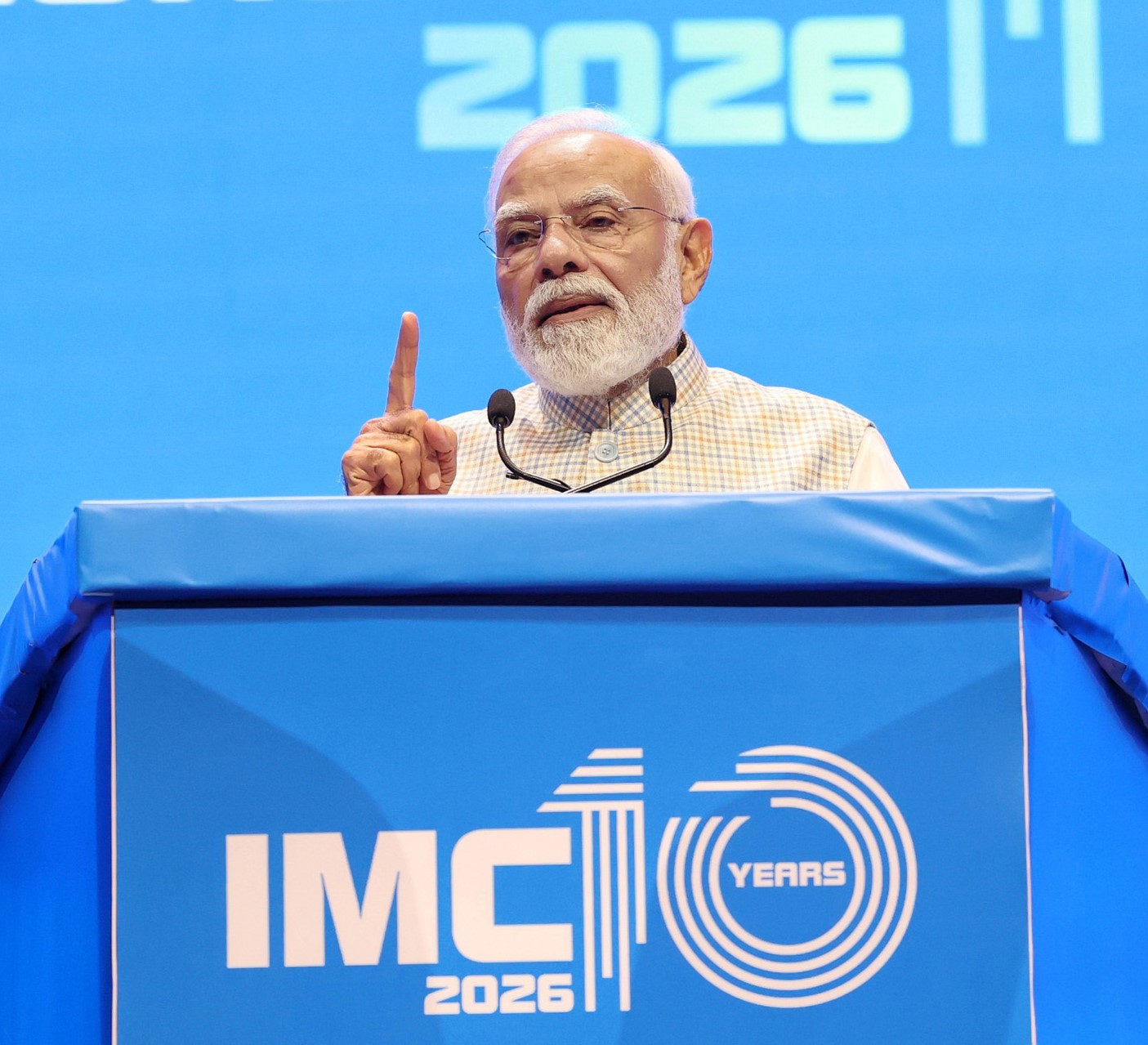

Says encouraging to see India's telecom sector steadily moving towards greater self-reliance.
NEW DELHI: Prime Minister Narendra Modi inaugurated the 10th edition of the India Mobile Congress (IMC) in New Delhi. Commemorating a deeply significant national milestone, the PM honored October 8th as Air Force Day, dedicating his opening thoughts to the nation's brave aerial defenders. He proudly offered his salutations to the courageous personnel safeguarding the skies."I bow to all our bravehearts and wish the country on Air Force Day,” affirmed Modi.
Reflecting on a monumental personal milestone, the PM shared his deep gratitude for completing exactly 25 years of continuous service as a Head of Government just the day prior. He warmly thanked every citizen and international friend who supported him throughout this natural journey of public service."I express my gratitude to every countryman and every friend of India around the world for their good wishes,” remarked Modi.
Highlighting a wonderful parallel of longevity, the PM celebrated the 10th anniversary of the India Mobile Congress while simultaneously noting the distinct honor of hosting the GSMA Board meeting in the country. He extended a wholehearted welcome to the entire global ecosystem of telecom operators, industry leaders, academics, and startups present.
Addressing with a heavy heart, the PM shared the somber morning news regarding the passing of the legendary actor Nana Patekar. He praised the brilliant artist for consistently winning the audience's hearts by bringing a diverse array of characters to life on screen. "He was a brilliant artist who won the hearts of audiences through different characters,” remarked Modi.
Eulogizing the late actor's profound national spirit, the PM described Nana Patekar as a fiercely independent soul whose life was entirely dedicated to the honor and glory of the tricolor. He characterized the late actor as a cinematic revolutionary whose sharp dialogue and powerful silence relentlessly struck against societal evils and anti-national elements."I pay my tributes to Nana Patekar ji and express my condolences to his family members and admirers,” affirmed Modi.
Tracing the remarkable evolution of digital connectivity through the lens of the India Mobile Congress, the PM recalled launching 5G from the very same stage in 2022 and predicting its massive expansion in 2023. He proudly announced that 5G networks, now operating from over 5.5 lakh base stations, have successfully reached every single district, boosting internet speeds tenfold. "Today we all are seeing 5G connectivity has reached every district of the country,” asserted Modi.
Reflecting on the platform's rising global stature, the PM recalled how the 2024 edition hosted the International Telecommunication Union to discuss global standards, while previous years focused heavily on domestic innovation and manufacturing. He credited the India Mobile Congress for emerging as a crucial catalyst for the nation's soaring telecom success and realizing its grandest dreams."In the past years, this platform has emerged as the platform of India's progress, of India's dreams,” noted Modi.
Embracing the summit's ambitious theme, the PM challenged the delegates to look at the nation's own transformative journey as the ultimate proof of scaling without boundaries. He promised to share how the country actively lived and executed this exact vision of limitless expansion."I would like to tell you from India's experiences how we have lived and demonstrated the dream of Scale without boundaries,” remarked Modi.
Redefining the fundamental purpose of connectivity, the PM explained that while global telecom debates obsess over spectrum, towers, and network speeds, the mobile phone has evolved into something far more profound for the domestic population."In the last 10-12 years, the mobile phone has emerged as a vital tool of good governance, serving as the absolute core of the Digital India vision” asserted Modi.'
Addressing the foundational motives behind the telecom boom, the PM acknowledged global amazement regarding the nation's data, affordable devices, and massive user base, but urged the audience to understand the deeper 'why' and 'how' behind these achievements. He explained that comprehending this underlying purpose reveals the exact focus area driving the nation forward. "When we understand this, everyone will find India's focus area crystal clear,” noted Modi.
Detailing the aggressive battle against digital exclusion, the PM recalled how modern technology was rapidly becoming an elite privilege just a decade ago. He explained that the Digital India campaign deliberately centralized the mobile phone to fiercely democratize technology, executing sweeping telecom reforms and vastly expanding infrastructure to ensure devices were manufactured domestically. "This was a very big effort for the democratization of technology,” affirmed Modi.
Showcasing the resilience forged by this digital democratization, the PM highlighted how widespread access to mobile phones and data drastically improved the Ease of Living for common citizens, famously keeping offices, banks, and schools running seamlessly during the global pandemic shutdowns. He celebrated how even the poorest children in remote villages can now effortlessly access quality digital education. "Digital learning is coming within everyone's reach,” asserted Modi.
Presenting staggering metrics to validate this educational revolution, the PM shared data from the national Diksha online platform. He revealed that during the peak of the pandemic up to July 2022, the platform facilitated over 5 billion learning sessions and 60 billion learning minutes."Now our effort is to connect about 25 crore students with all our digital and online education mediums,” affirmed Modi.
Explaining how technology unified a vastly heterogeneous nation, the PM noted that mobile connectivity systematically dismantled the immense geographic and linguistic barriers that previously hindered daily life. He highlighted that before the digital shift, citizens wasted massive amounts of time and money traveling to urban centers just to access basic banking, healthcare, and government services."Mobile connectivity has connected this diversity with convenience as well,” observed Modi.
Detailing the monumental financial integrity achieved through digital governance, the PM proudly stated that over 50 lakh crore rupees have been transferred directly to beneficiaries via mobile platforms, effectively preventing 5 lakh crore rupees from leaking into corrupt hands. He specifically highlighted the PM Kisan Samman Nidhi, which has securely deposited over 4 lakh crore rupees directly to marginalized small farmers who previously never saw government benefits."Now that same money is reaching the right beneficiary,” asserted Modi.
Summarizing the ultimate philosophy behind this technological empowerment, the PM declared that mobile phones transcended simple chatting to guarantee less travel, less waiting, lower costs, and vastly more convenience. He branded this sweeping holistic transformation as the ultimate return on technological investment for the common man." This is Technology's biggest Citizen Dividend,” affirmed Modi.
Highlighting the economic chain reaction triggered by robust infrastructure, the PM explained how remote tower installations, massive optical fiber rollouts, and cheap data birthed entirely new sectors in the economy. He noted that this foundational expansion generated a massive wave of new consumers and creators across technology, entertainment, and education. "This has also created new sectors in the economy,” noted Modi.
Spotlighting the explosive growth of the interactive entertainment sector, the PM shared that over 50 crore people, heavily concentrated among the youth in Tier-2 and Tier-3 cities, are now actively engaged in the gaming ecosystem. He praised these young digital natives for evolving from mere players into competitive e-sports athletes, content creators, and ambitious business owners."Meaning, the mobile phone in India is today a gaming console as well and has also become a studio of creation,” remarked Modi.
Celebrating the democratization of the creator economy, the PM explained how rapid connectivity and affordable data successfully pushed video-sharing platforms and regional OTT services deep into rural towns, breaking down historical language barriers. He revealed that the content creation industry alone has ballooned into a multi-thousand-crore sector, providing lucrative livelihoods for millions."Meaning, the mobile phone has also democratized content creation in India,” asserted Modi.
Pivoting to the critical imperative of cybersecurity, the PM stressed that as telecom and digital technologies become fundamental to daily life, fortifying the security framework surrounding phones and networks is an absolute national priority. He emphasized that for the common citizen, complex architectural protocols matter far less than the simple, fundamental assurance of safety."For him, trust is very important,” noted Modi.
Detailing the granular expectations of digital trust, the PM painted a clear picture of user security, insisting that citizens must absolutely know the true identity of callers, verify the authenticity of messages, and feel entirely secure when executing payments or sharing personal data. He made it clear that consumer confidence is the absolute bedrock of digital expansion."When he provides his data in any form, he should have the trust that his data is safe,” affirmed Modi.
Calling for unified international action against borderless digital threats, the PM warned that cyber fraud and deepfakes exploit global vulnerabilities, requiring an urgent, coordinated Global Framework uniting governments, tech companies, operators, and financial institutions. He explicitly challenged the GSMA to help engineer proactive mechanisms capable of intercepting fraud before it ever reaches the end user."India is always ready to share its experiences with the world,” asserted Modi.
Focusing on the strategic horizon, the PM reminded the delegates that with only four years left in the current decade, their immediate summit discussions will forge the crucial roadmap guiding the global mobile market into the future. He framed the event as a pivotal planning ground for the next era of technological dominance." This roadmap will give direction to the mobile market of the entire world along with India,” noted Modi.
Outlining the ultimate vision for technological sovereignty, the PM declared that the nation has successfully transitioned from a consumer to a creator, and is now aggressively charging toward complete domestic control over product design, underlying technology, and intellectual property. He assured the industry that the government is rapidly modernizing decades-old laws, deploying comprehensive incentives, and executing sweeping regulatory reforms like the Telecommunications Act and the GatiShakti portal to ensure success."Meaning, in the telecom sector as well, the reform express is moving forward rapidly,” asserted Modi.
Providing an update on critical hardware localization, the PM announced that the domestic semiconductor manufacturing ecosystem is accelerating rapidly, with commercial production already live across five locations. He declared that the next phase of the India Semiconductor Mission will aggressively target the localization of the entire supply chain."Meaning, India is taking big steps in every area related to the telecom sector,” affirmed Modi.
Concluding his address with a soaring call to action, the PM challenged the India Mobile Congress to transcend being a mere technology showcase and instead become the ultimate crucible for humanity-serving innovations, research, and partnerships that will power the grand resolution of a developed nation. He expressed his expectation that the attendees will tirelessly strive to transform the platform into the premier global junction for industry and ideas."I am confident that you all will keep making wholehearted efforts for this, with this expectation, once again, many best wishes to all of you,” remarked Modi.