
Police arrest over 2400 protestors with nearly 1000 police personnel injured in protests.
NEW DELHI: France is grappling with widespread unrest following nationwide protests over rising living costs, deteriorating public services and poor conditions in schools, with demonstrations over the weekend escalating into clashes, looting and arson in several major cities.
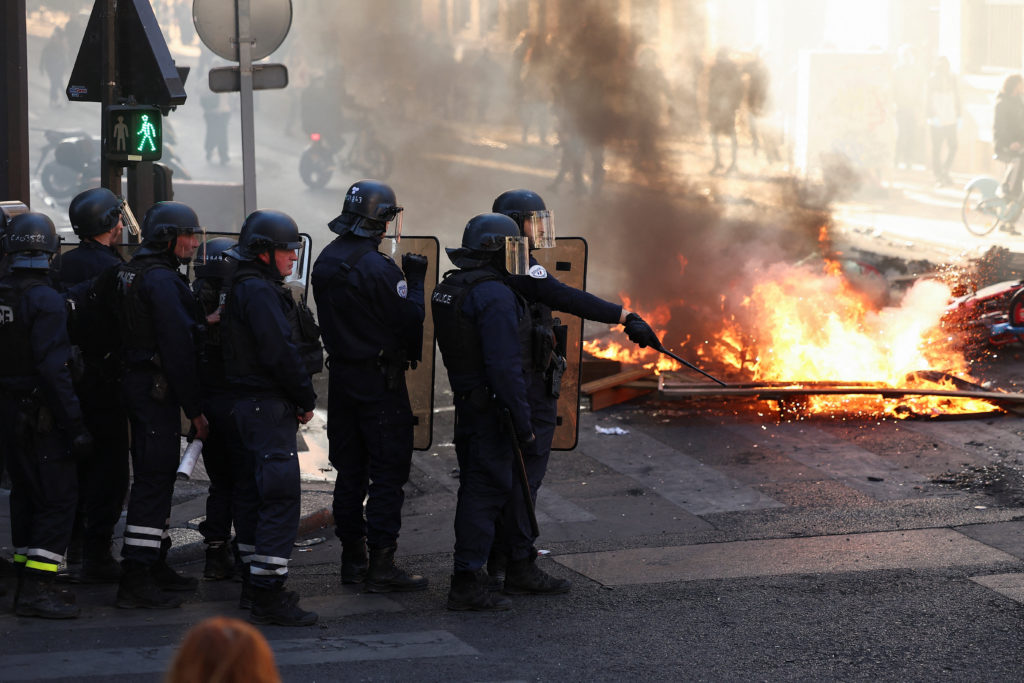
President Emmanuel Macron condemned the violence and called for calm, while acknowledging that peaceful demonstrators had legitimate grievances. Authorities reported around 2,400 arrests nationwide, and nearly 1,000 police officers and gendarmes were injured, according to Reuters. One protester also died after suffering a cardiac arrest during demonstrations in Paris.
The protests drew between 550,000 and 800,000 people across the country, depending on the estimates provided by the Interior Ministry and organisers. Although the majority of demonstrations were peaceful, violent groups attacked public buildings, damaged businesses and clashed with police.
Some of the worst incidents were reported in Paris, Marseille, Lyon, Bordeaux and Limoges. In Limoges, a historic town hall was set on fire, while public buildings and commercial establishments were targeted in other cities.
In Paris, police used tear gas as clashes erupted around Place de la République. Shops were looted, street furniture was damaged and fires were reported in several locations. Authorities also carried out a major clean-up operation across affected cities as residents and businesses assessed the damage.
The scale of the destruction has raised concerns about public safety, the protection of commercial establishments and the ability of authorities to manage large demonstrations.
The demonstrations began in September with high school students protesting teacher shortages, inadequate school facilities and concerns about education funding. The movement subsequently expanded to include trade union members, students and other sections of society dissatisfied with living standards and government spending priorities.
Rising prices, housing pressures and concerns about public services have broadened the protests beyond education. The movement has also drawn comparisons with France’s 2018 Yellow Vest demonstrations, which were initially sparked by opposition to fuel tax increases and developed into a wider expression of economic discontent.
Reuters reported that more than half a million people participated in Saturday’s demonstrations, highlighting the breadth of public dissatisfaction.
While addressing the nation, Macron condemned looting and attacks on public property, saying those responsible would be held accountable. At the same time, he stressed the need to distinguish peaceful demonstrators with legitimate demands from individuals involved in violence.
The government has blamed radical far-left groups and criminal elements for much of the unrest. Officials have vowed to pursue those responsible for attacks on police, public buildings and businesses.
Macron stopped short of declaring a nationwide state of emergency but indicated that local authorities could impose restrictions on demonstrations where necessary to protect public property and businesses. <Cite refs={["turn809331news24","turn809331news12"]}/>
The unrest has intensified scrutiny of the government’s handling of economic grievances, public services and law enforcement. Opposition leaders have criticised the administration, while concerns over police tactics have added another dimension to the controversy.
The protests come ahead of France’s 2027 presidential election, making the cost of living, education, public spending and public order increasingly prominent political issues.
With the government facing pressure to restore order while addressing demonstrators’ concerns, the coming days are likely to test its ability to contain the unrest and rebuild public confidence.
The immediate challenge for French authorities is to prevent further violence while ensuring that peaceful protest remains possible and that the underlying economic and social grievances receive attention.